page

Showing posts with label RNA-seq. Show all posts

Mar 31, 2021

DEG analysis without biological Replication

 DEG analysis without biological Replication

https://www.researchgate.net/post/DEG_analysis_without_biological_Replication


->
Without replicates, you cannot estimate which genes are differentially expressed using EdgeR or DESeq2. You can only calculate fold changes based on normalized read counts (preferentially CPM normalized by TMM method included in any EdgeR analysis) and apply a stringent fold-change cut-off to determine which genes are more or less expressed depending on the condition.

->
it might be able to assume certain samples as biological replicates. I recommend you check your samples' clustering using a PCA plot (explained in the DESeq2 manual/workflow), this  is a good way of exploring your data. For example, if you have 4 control samples and 4 treatment samples it might be that all your control samples make one o group and they together differentiate from your treatment samples. If this is the case, one could argue that for the purpose of analysing DEG between treatment and control one could consider all the control samples as replicates, same would apply for the treatment samples. However, the relevance of this approach will depend on the nature of the experimental setup.

Mar 10, 2021

RSEM : RNA-Seq transcript quantification

RSEM: accurate transcript quantification from RNA-Seq data with or without a reference genome

 BMC Bioinformatics volume 12, Article number: 323 (2011) 

 https://bmcbioinformatics.biomedcentral.com/articles/10.1186/1471-2105-12-323

RNA-Seq gene expression estimation with read mapping uncertainty

Bioinformatics, Volume 26, Issue 4, 15 February 2010, Pages 493–500

 https://doi.org/10.1093/bioinformatics/btp692


RSEM tutorial

https://github.com/bli25broad/RSEM_tutorial

May 31, 2019

Normalization method of DESeq2, CPM, TPM, FPKM, TMM

Clear description for normalization method and DESeq2 normalization process (recommend)

https://hbctraining.github.io/DGE_workshop/lessons/02_DGE_count_normalization.html


Gene expression units explained: RPM, RPKM, FPKM, TPM, DESeq, TMM, SCnorm, GeTMM, and ComBat-Seq  : include python, R code (recommend)

https://www.reneshbedre.com/blog/expression_units.html


calculation of CPM, TPM, FPKM ; R code (recommend)

https://haroldpimentel.wordpress.com/2014/05/08/what-the-fpkm-a-review-rna-seq-expression-units/


How to normalized TPM with TMM method?

 https://www.biostars.org/p/388584/

 ->you have TMM factors and want to compute TPMs.

TMM factors can in principle be used to compute TPMs. In edgeR, any downstream quantity that is computed from the library sizes will incorporate the TMM factors automatically, because the factors are considered part of the effective library sizes. TMM normalization factors will be applied automatically when you use

CPM <- cpm(dge)

or

RPKM <- rpkm(dge)

in edgeR to compute CPMs or RPKMs from a DGEList object. I don't necessarily recommend TPM values myself, but if you go on to compute TPMs by

TPM <- t( t(RPKM) / colSums(RPKM) ) * 1e6

then the TMM factors will naturally have been incorporated into the computation.


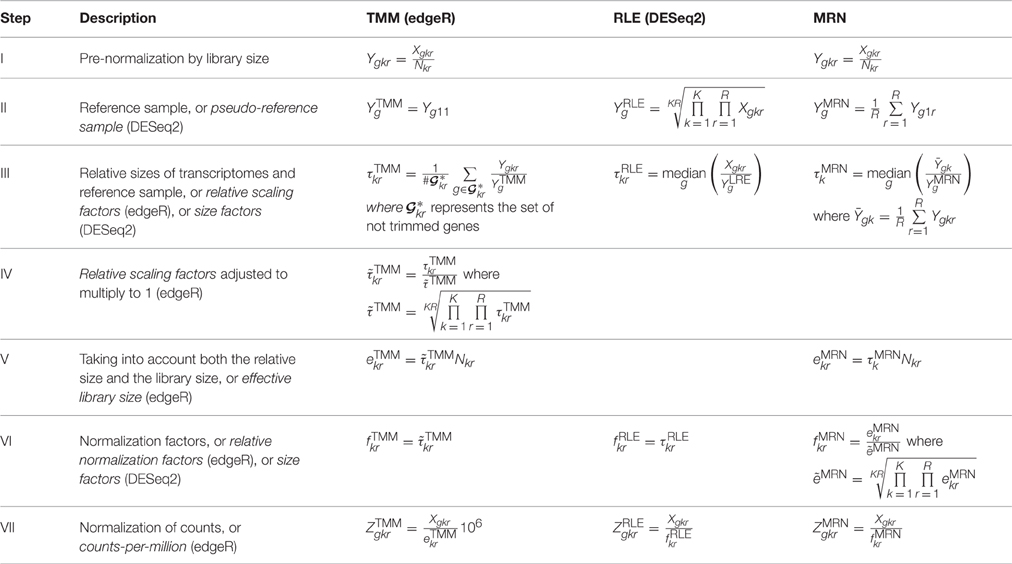
TMM (edgeR), RLE (DESeq2), and MRN Normalization Methods comparison

https://www.frontiersin.org/articles/10.3389/fgene.2016.00164/full
https://www.frontiersin.org/files/Articles/203326/fgene-07-00164-HTML/image_m/fgene-07-00164-t002.jpg

Apr 18, 2018

RNA-seq analysis is easy as 1-2-3 with limma, Glimma and edgeR

https://www.bioconductor.org/help/workflows/RNAseq123/

voom: precision weights unlock linear model analysis tools for RNA-seq read counts

https://genomebiology.biomedcentral.com/articles/10.1186/gb-2014-15-2-r29


linear modeling for RNA-seq count data


Abstract
New normal linear modeling strategies are presented for analyzing read counts from RNA-seq experiments. The voom method estimates the mean-variance relationship of the log-counts, generates a precision weight for each observation and enters these into the limma empirical Bayes analysis pipeline. This opens access for RNA-seq analysts to a large body of methodology developed for microarrays. Simulation studies show that voom performs as well or better than count-based RNA-seq methods even when the data are generated according to the assumptions of the earlier methods. Two case studies illustrate the use of linear modeling and gene set testing methods